
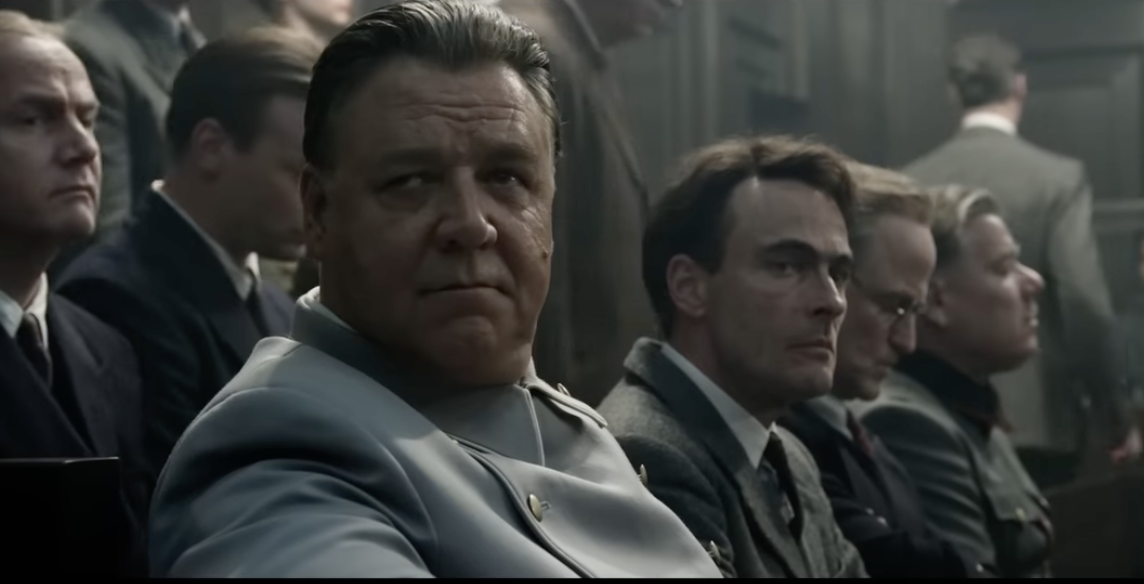


Nuremberg is a post–World War II psychological thriller by James Vanderbilt, adapted from Jack El-Hai’s The Nazi and The Psychiatrist. Russell Crowe is nearly unrecognizable as Hermann Göring, while Rami Malek is well cast as U.S. Army psychiatrist Dr. Douglas Kelley, who is sent to study Nazi war criminals and determine their fitness for trial.
Michael Shannon’s stoic Robert Jackson—lead prosecutor and Supreme Court Justice—champions due process despite widespread calls for immediate execution. His push for an international tribunal lays the groundwork for the Nuremberg Trials.
The film opens with Göring’s theatrical surrender and transfer to Camp Ashcan. Crowe leans into Göring’s sweaty pomposity, while Kelley’s train ride—complete with card tricks and a flirtatious encounter—foreshadows his blend of charm and detachment. Kelley arrives nervous about facing Göring, accompanied by interpreter Sgt. Howie Triest (Leo Woodall), who gradually becomes the story’s moral anchor. Göring, oddly charismatic, is introduced in tight close-ups that highlight his narcissism; Kelley exposes his feigned ignorance of English with a pointed insult, launching their psychological cat-and-mouse.
Kelley builds rapport by engaging Göring’s family and maintaining patient confidentiality, even as Göring mistakes professionalism for friendship. Their sessions probe guilt, legacy, and denial, with Crowe delivering an awards-worthy portrayal steeped in conviction and delusion.
Kelley’s ethics blur—he withholds information from intelligence officers, feuds with a colleague, and drunkenly divulges Göring’s secrets to the journalist he met on the train. His dismissal coincides with Sgt. Triest’s revelation of his Jewish identity and murdered parents, prompting Kelley to witness the trial.
The film peaks as Göring strides into the courtroom like a performer. The central conflict—fascism versus democracy—intensifies with graphic camp footage that leaves Göring unmoved. Jackson prosecutes relentlessly while Göring quibbles over interpretations. A British colleague redeems himself by using Kelley’s notes to strengthen the closing arguments.
While some supporting characters could have been developed further, Crowe and Malek embody their roles, and the complex relationship between the two men feels authentic. The cinematography maintains momentum in a dialogue-heavy film with a large cast. The audience flinched repeatedly during scenes of German soldiers’ tributes to the Nazi party, intensified by powerful sound design. Ultimately, the film has the power to spark vital conversations about how people come to justify evil.
In the end, Nuremberg reflects not only on the war’s aftermath but also on the enduring fragility of justice and humanity.
For KSQD’s Film Gang: Susan Lovegren