

Hello, I’m Daymia Rousseau, a UCSC Intern reporting for KSQD. In 2023, Santa Cruz county experienced one of the worst storms in the city’s history. In cities like Capitola, streets were flooded , waves crashed into various businesses, and the wharf was destroyed. Meteorologists called it a bomb cyclone with lots of rain and wind. As Santa Cruz county endures storm season once again, many coastal communities remain anxious about another natural disaster, or how California’s coast will handle storms as sea-levels rise.
Griggs“What’s gonna be more problematic…in the relatively near-term in the year 2050, or the year 2075, will be these short-term extreme events we witnessed these past three winters… so really high tides, and really large waves.”
Daymia: That’s Gary Griggs, Professor of Earth and planetary Sciences at UCSC. He’s, an author, scientific reporter, & board member of the Ocean Science Trust. Professor Griggs’ is an expert in climate modeling and sea-level rise. His recent research has also projected a 0.5-1.2ft sea level rise by the year 2050. What might our future coastline look like with this change?
Griggs “So we really have two, well, maybe three different kinds of coastal environments… one is… steep coastal mountains, plunging thousands of feet to the water. A foot or two doesn’t really make a difference…Then we have places like much of Santa Cruz county…these coastal marine terraces, these flat benches. We may have a beach in front of there, we may not. But what happens as sea levels continue to rise, and as storms continue, we erode back that bluff. West cliff might be the best example of this… The third, where we will see this the most, probably the clearest, are lowline areas, which are nearly at sea level now. And we look at, say, the waterfront of Santa Cruz beach, Seabright, Capitola, and Rio Del Mar…many of the homes and businesses were built on the beach, so a foot or two will really make a difference…”
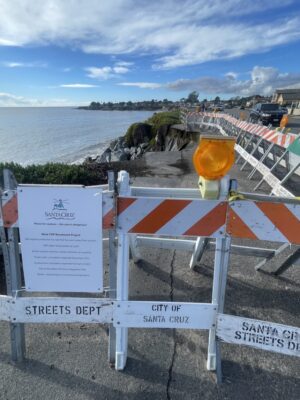
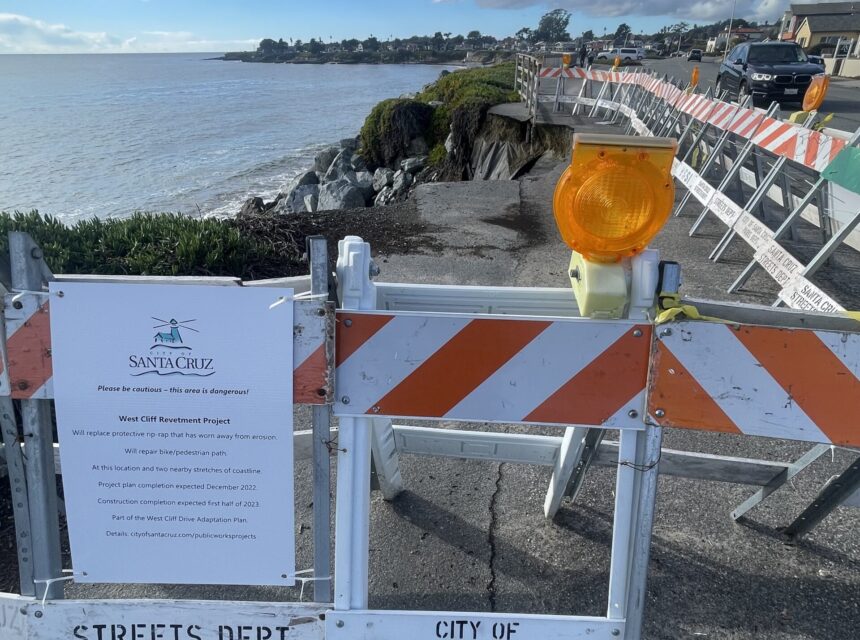
Daymia: 2023 saw intense storm damage at places like West Cliff Drive, where whole sections of roadway fell into the sea. The city of Santa Cruz has established a 5-year roadmap to monitor sea level rise and minimize the eroding impacts of storms. This includes a new coastal change monitoring network, incentivized storm water management, and infrastructure redesign. Each project could cost upwards of tens of millions of dollars. Additionally, Beaches like Capitola and Rio Del Mar will be more susceptible to flooding & sand buildup all year, not just in winter.
Griggs“So, we’ve got this preoccupation with sea level rise, though we need to keep in mind these short term events, which are gonna be way more problematic.”
Daymia: Michael W. Beck, the director of the UCSC Center on Coastal Climate Resilience, raisesd concerns about sea-level rise’s impacts on marine wildlife, as well as coastal communities. In a 2024 article he stated, quote, “it’s not just a huge bummer for future summer vacations…Our beaches also provide a natural buffer from flooding, erosion and other natural disasters for millions of California residents.” Professor Griggs is not so sure all of these beaches will provide a buffer when the really big storms hit.
Grigs “A lot of his work is based on the tropics, where we have coral reefs and mangroves that live in salt water that do provide this natural buffer. So if we have this really wide beach – I’m gonna pick Sea Bright beach – they definitely provide a buffer. By the time you get to Capitola… in the winter, there’s not much there, and as you saw, the waves come over that little sea wall into the downtown, into the restaurants… So I’m less optimistic in my consideration of how important those beaches are. They’re definitely important, but when you get a big winter, all bets are off…Capitola’s been hit with at least 15 major storms in the last century..”
Daymia: As of January 5th, intense winds & flooding have damaged much of the Santa Cruz Harbor, and East Cliff Drive. They’ve also collapsed a huge portion of West Cliff Drive – sabotaging two years of reconstruction efforts. It begs the question: why do homeowners & city planners continue to fund reconstructive efforts when storms undo them? Is California in a losing battle with a shrinking coastline?
Griggs. We have what I like to call, ‘disaster amnesia’…Insurance begins to weigh in here. As long as you can keep getting insured, and I think the federal funding insurance programs are beginning to back up and say, ‘what a minute, we can’t keep reinsuring places.’”
Daymia “In light of that, and considering places like Capitola, or even Rio Del Mar… What do you think the future of California coastal housing might look like in the future, as this continues?”
Griggs: (Laughing)
Daymia (Laughing), “Yeah, I can already tell from that laugh, haha!”
Griggs “There’s a great book if you haven’t seen it…It’s by Rosanna Xia, and it’s called, ‘California Against the Sea’. She talked to a number of coastal communities… there’s those people who live in these cities who are never gonna move back… and then there’s the people like engineers and geologists saying ‘this is gonna happen again, and again, and it’s not safe’…I worked with a lot of coastal homeowners who were trying to build seawalls, trying to repair seawalls… There’s clearly a limited amount of choices – how we deal with it. One is denial. (Laughs). That’s what they’re doing in Florida…the second is what we’ve been doing: Armor. Building sea walls, making defenses… There’s basically nothing we can do, in the long run, to hold back the Pacific ocean.”
The city’s short-term responses, such as reconstruction efforts, and importing sand to beaches like Rio Del Mar with federal budgets seem like short-term fixes.Will the idea of planned retreat eventually take hold, or will the cycle continue as is? Stay tuned for the next atmospheric river to find out.
Thanks for listening. This is Daymia Rousseau, UCSC Intern reporting for KSQD.
https://www.universityofcalifornia.edu/news/why-californias-beaches-are-shrinking-and-what-we-can-do-save-them
https://www.gary-griggs.com/https://ecm.cityofsantacruz.com/OnBaseAgendaOnline/Documents/ViewDocument/5-YEAR%20R