Update: The second installment of this musical essay series is now available for listening on the “Archived Musical Essays” webpage, along with the corresponding playlist on the “Program Playlists” webpage, of the Tower of Song website.
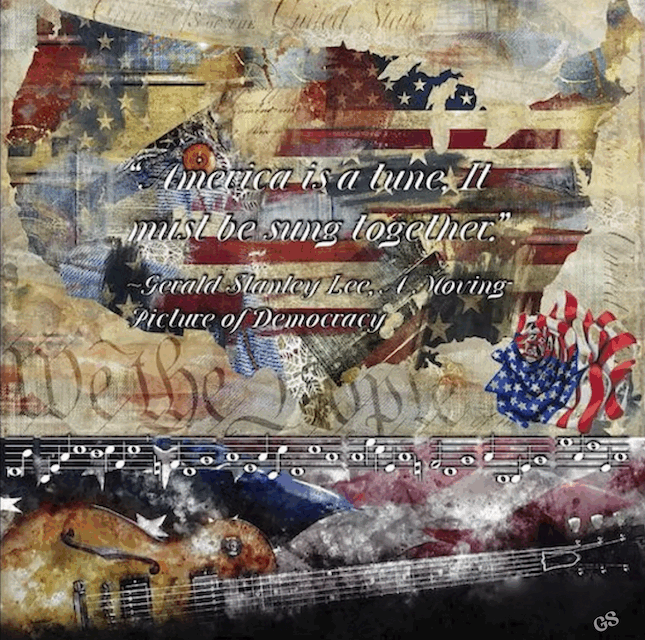
The Orphic Essay-with-Soundtrack series for Independence Day 2025 is entitled “Romantic Total Revolution: The Democracy of Soul & The Goddess Of Liberty.”
This second part of the musical essay series continues where the first part left off presenting the ideal of America from a few visionary European Romantics (i.e., William Blake, Friedrich Schiller, and Alexis de Tocqueville). This ideal of American democracy was based upon America’s sublime wilderness, as de Tocqueville put it (Democracy In America), “The land itself rather than the institution was the lifeblood of democracy.” In other words, for the Romantic vision of America, democracy and nature go hand-in-hand.
Accordingly, part 2 of this musical essay series now turns to the ideal of America based upon the writings of two American Romantics, Ralph Waldo Emerson and Walt Whitman, whom the GS credits as envisioning America as a “democracy of soul” based upon Emersons “metaphysic of democracy” and Whitman’s “democracy of mystic unity” (out of the blending democracy, poetry, and eros). It then goes on to again engage in the process of re-mythologizing the image of America and its symbols, specifically the American revolutionary figure of “Lady Liberty” (whom the revolutionary atheist, Thomas Paine, poetically referred to as “The Goddess of Liberty”), later symbolized by the Statue of Liberty. (A national figure whom the GS identifies mythologically as “The Goddess of Democracy.”) Therefore, part 2 of this musical essay series builds upon the radical idea about America articulated in part 1; to wit, America is essentially a visionally idea or a dream (of liberty), and is thus as much a product of the literary imagination—the Romantic Imagination—as are the sum total of its real-world institutions. (Here, it is significant that literary historians have called Romanticism in America—the Romanticism of Emerson, Whitman, and Thoreau—the “American Renaissance,” and its contribution in creating the identity of America has been called a “literary democracy.”) Finally, this 2nd installment resumes the GS’ overall argument that uniting mythopoetics and political ideology (i.e., the Romantic tradition of the imagination and the political tradition of democracy) create a “para-politics,” through which the old 60s adversaries, the Neo-Marxist politicos and the Countercultural mysticos, can come together (“over me”)—and dance in the street (as a form of carnivalesque protest)!
In conclusion to this synopsis of the content of this second installment of this musical essay for Independence Day, suffice to say the GS feels that given the current threat to our democratic form of government this information should serve as a needful reminder about the visionary roots of American democracy and the “eternal hope” that went along with it.
Be sure to check out the fantabulous “Independence Day” webpage dedicated to this musical essay, which is located on the Tower of Song website at revradiotowerofsong.com.